
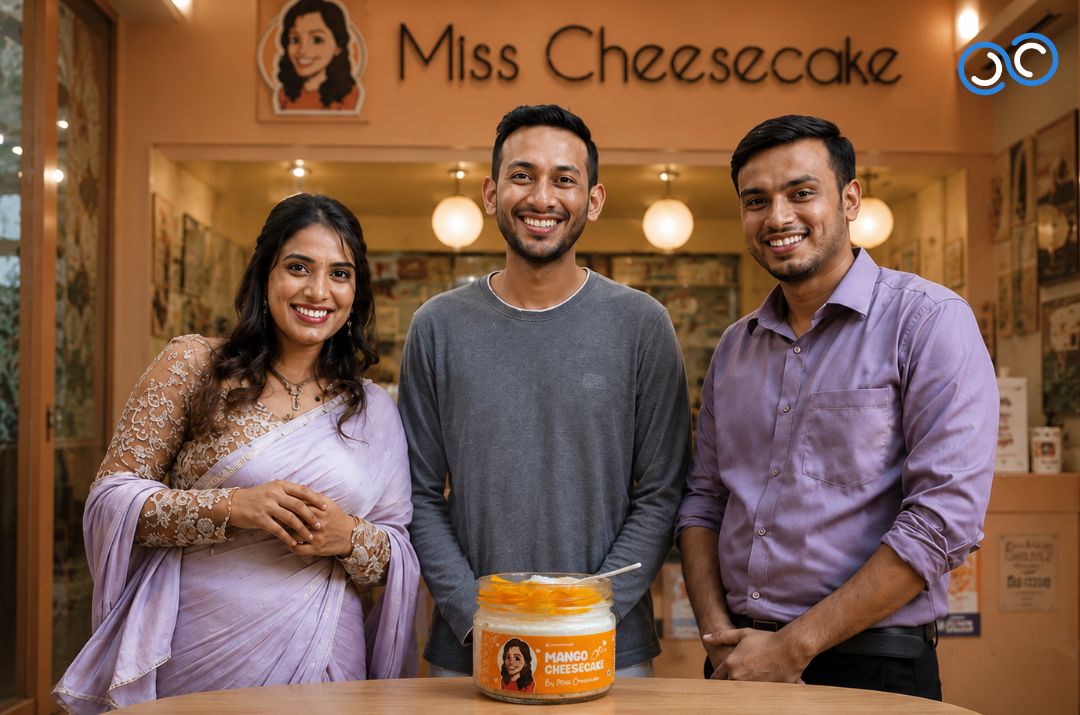

Miss Cheesecake Success Story: From ₹5,000 to a ₹1.20 Crore Dessert Brand
What if ₹5,000 could become a ₹1.20 crore annual-revenue business?
That is the story behind Miss Cheesecake, a Jodhpur-based dessert brand founded by Pooja Balani and later joined by Narpat Singh Rathore as co-founder.
The business began as a home-kitchen experiment in 2023 after Pooja discovered cheesecake during a trip to Jaipur. With no professional baking background, she learned through YouTube and experimentation, made her first cheesecake products and started selling them locally.
What began with just ₹5,000 eventually became a business generating ₹1.20 crore in revenue during 2025, according to reporting on the founders' journey. The company also appeared on Shark Tank India Season 4, where the founders asked for ₹30 lakh for 5% equity at a ₹6 crore valuation but did not close a deal.
Key Highlights
- Founder: Pooja Balani
- Co-founder: Narpat Singh Rathore
- Business started: 2023
- Initial investment: ₹5,000
- Additional founder investment: Around ₹5 lakh
- First physical outlet: Jodhpur
- Current presence: Jodhpur and Jaipur
- 2024 revenue: ₹48 lakh from May to December
- 2025 revenue: ₹1.20 crore
- Monthly revenue/run-rate: Around ₹8–8.5 lakh
- Product positioning: Eggless, vegetarian and gelatin-free cheesecakes
- Shark Tank India Season 4 ask: ₹30 lakh for 5%
- Implied valuation on Shark Tank: ₹6 crore
- Institutional funding: No confirmed venture-capital round
The company's official website identifies Pooja Balani and Narpat Singh Rathore as its founders and places the beginning of the brand in November 2023.
Who Is Pooja Balani?
Pooja Balani is the founder of Miss Cheesecake and a Jodhpur-based entrepreneur.
She holds an MCA degree and had worked in a marketing role before leaving her job.
Her entrepreneurial journey began after she tasted cheesecake during a trip to Jaipur and realized that the dessert category had relatively limited awareness in her hometown.
Rather than treating the idea as a hobby, she started experimenting at home.
She had no formal baking experience, so she learned through online resources, repeated trials and recipe experimentation.
Her story became particularly well known after she appeared on Shark Tank India and spoke openly about the personal pressure she faced after leaving her job.
How Did Miss Cheesecake Start?
Miss Cheesecake started from Pooja's home kitchen in Jodhpur in 2023.
The initial investment was only around ₹5,000, which was used to purchase ingredients, jars and other basic materials.
Instead of immediately opening a store, Pooja tested the product through small-scale selling opportunities, including stalls and local exhibitions.
This allowed her to validate whether people were actually willing to pay for the product before taking on major fixed costs.
That approach was important.
The first question wasn't
How big can this brand become?
It was
Will people in Jodhpur actually buy cheesecake?
The ₹5,000 Experiment
The early business was extremely simple.
₹5,000 → Ingredients → Cheesecake jars → Local customers → Feedback → Better product
The founders focused on an affordable and accessible cheesecake format rather than an expensive premium bakery experience.
This helped them test demand with limited capital.
The company eventually moved from the home kitchen to a physical outlet after Narpat Singh Rathore joined the business and invested around ₹5 lakh toward the first store.
Who Is Narpat Singh Rathore?
Narpat Singh Rathore joined Miss Cheesecake as a co-founder as the business moved toward its next stage of growth.
While Pooja focused heavily on the product and kitchen operations, Narpat brought business and operational expertise to the company.
His investment of around ₹5 lakh helped the founders establish their first physical outlet in Jodhpur.
The first store was reportedly only around 100 square feet.
This was another important step in the company's journey
Home Kitchen → Small Store → Repeat Customers → Higher Revenue
From a Home Kitchen to a Physical Store
The first physical outlet gave Miss Cheesecake a permanent customer touchpoint.
Instead of relying only on home production and temporary stalls, the brand could now build a consistent local presence.
The founders also documented the process of building the store through Instagram content.
This became an important part of their marketing strategy.
They were not simply promoting cheesecakes.
They were showing people the journey of building the business.
Miss Cheesecake's Revenue Growth
The company's financial growth became one of the most impressive parts of its story.
From May to December 2024, Miss Cheesecake reportedly generated approximately ₹48 lakh in revenue.
During 2025, annual revenue increased to approximately ₹1.20 crore.
The business was also reported to be generating around ₹8–8.5 lakh in monthly revenue.
This represents a significant increase from the original ₹5,000 experiment.
The growth can be summarized as
₹5,000 initial investment → ₹48 lakh revenue in 2024 → ₹1.20 crore revenue in 2025
What Does Miss Cheesecake Sell?
Miss Cheesecake focuses primarily on cheesecake products designed around affordability and convenience.
The brand is particularly known for cheesecake jars and different flavors.
Its product positioning includes
- Vegetarian products
- Eggless cheesecakes
- Gelatin-free products
- Freshly prepared desserts
- Multiple cheesecake flavors
- Affordable individual portions
The brand's focus on jar-based desserts also makes the product easier to package, transport and sell through delivery channels.
Why Is the Product Different?
Cheesecake has traditionally been positioned as a premium dessert in many Indian markets.
Miss Cheesecake attempted to make the category more accessible.
Instead of building around an expensive dine-in dessert experience, the company focused on:
Affordable pricing + Individual portions + Strong flavors + Convenient packaging
This makes the product suitable for impulse purchases, celebrations, gifting and everyday dessert consumption.
The In-House Cream Cheese Strategy
One of Miss Cheesecake's notable operational choices is making its cream cheese in-house.
This can help the business reduce dependence on expensive external suppliers and maintain greater control over its product.
It can also improve cost management when the business reaches sufficient production volume.
According to founder-related reporting, the business has reported gross margins of around 50% and net margins around 35%, although these figures are founder-reported rather than independently audited financial statements.
This distinction is important.
For a food business, healthy margins can create the cash flow required to expand without relying heavily on outside capital.
Miss Cheesecake's Marketing Strategy
One of the biggest growth drivers has been organic social media.
The founders documented their journey through Instagram reels, including the process of building their physical outlet.
Instead of creating highly polished corporate advertising, they showed
- The founders
- The kitchen
- Store construction
- Product preparation
- Business challenges
- Daily operations
- Growth milestones
This created a story that audiences could follow.
The result was significant organic reach.
One of the brand's reels reportedly crossed 60 million views, giving the company substantial visibility without requiring a comparable traditional advertising budget.
Why Did the Content Go Viral?
The content worked because it combined several elements.
Founder Story
People were able to connect with the individuals behind the brand.
Transformation
The audience could see the business evolve from a small kitchen operation into a physical store.
Transparency
The founders showed the actual process instead of presenting only the finished product.
Small Starting Point
The ₹5,000 starting point made the story relatable to aspiring entrepreneurs.
Progress
Every new milestone created another reason for people to follow the journey.
This created an important marketing loop
Story → Content → Views → Awareness → Customers → More Story
Miss Cheesecake on Shark Tank India
Miss Cheesecake appeared on Shark Tank India Season 4.
Pooja Balani and Narpat Singh Rathore asked for
₹30 lakh for 5% equity
This implied a valuation of
₹6 crore
The pitch attracted attention from the sharks, particularly because of the founders' story and the company's growth.
However, the founders ultimately did not close an investment deal on the show.
What Happened After Shark Tank?
Although Miss Cheesecake did not secure a deal, the appearance still created significant value for the brand.
The founders received national exposure.
Ritesh Agarwal was particularly impressed by the business and shared his contact information with the founders despite no deal being finalized.
The founders later said their sales increased significantly following the episode.
This demonstrates an important point
Shark Tank is not only about raising money.
For consumer brands, television exposure can also become a powerful customer-acquisition and brand-awareness event.
Miss Cheesecake's Business Model
The company operates as a direct-to-consumer dessert business with physical and delivery-oriented operations.
Its model combines
Product manufacturing + Physical retail + Online discovery + Delivery
The company has operated a dessert store in Jodhpur and a delivery-focused cloud-kitchen setup in Jaipur, according to founder-related reporting.
This gives the brand multiple customer-access channels.
Physical Store
The store creates local visibility and direct customer interaction.
Cloud Kitchen
The cloud-kitchen model allows the company to serve delivery demand without requiring a large dine-in footprint.
Social Media
Instagram functions as both a marketing channel and customer-acquisition engine.
Product Packaging
Cheesecake jars make individual portions easier to sell, transport and deliver.
Why the Business Can Scale
The dessert category has several characteristics that can support a scalable business.
First, the products are relatively easy to standardize.
Second, individual portions simplify pricing.
Third, delivery allows the company to reach customers beyond the immediate store location.
Fourth, a centralized kitchen can potentially supply multiple smaller outlets.
This creates the possibility of a hub-and-spoke expansion model
Central Kitchen → Small Kiosks/Outlets → Local Delivery
Such a model can potentially reduce the need for a full production kitchen at every location.
The founders have discussed plans around central kitchens, kiosks and broader expansion.
The Biggest Challenges
Miss Cheesecake's journey wasn't without challenges.
The founders had to overcome several barriers.
No Professional Baking Background
Pooja did not begin as a trained pastry chef.
She had to learn the product from scratch.
Limited Initial Capital
The business began with only ₹5,000.
Family Pressure
Pooja has spoken publicly about facing pressure to leave her entrepreneurial path and get married after quitting her job.
Building a Physical Store
Moving from a home kitchen to a physical outlet required additional capital and operational planning.
No Shark Tank Deal
The founders left Shark Tank without an investment, meaning they had to continue building without the capital they had hoped to raise.
Instead of stopping, they continued growing the business.
What Makes Miss Cheesecake Strong?
Several elements stand out in the company's model.
Product Differentiation
Eggless, vegetarian and gelatin-free products create a clear positioning for the Indian market.
Affordable Format
Individual cheesecake jars make the product easier to try without committing to a large premium dessert.
In-House Production
Producing cream cheese internally can provide greater control over costs and quality.
Founder-Led Marketing
The founders themselves became part of the brand story.
Organic Distribution
Viral social content has helped the company reach customers without relying entirely on paid advertising.
Local Market Focus
The company first established itself in Jodhpur before expanding its operating footprint.
The Power of Starting Small
Miss Cheesecake is a useful example of why founders don't always need a large initial investment to test a consumer idea.
The company started with
₹5,000
Not
₹50 lakh
Not
₹5 crore
The founders first validated the product at a very small scale.
Only after seeing demand did they increase their investment and open a physical location.
This is a classic example of
Test → Validate → Reinvest → Scale
What Can Founders Learn From Miss Cheesecake?
Start Before Everything Is Perfect
Pooja did not have professional baking experience when she started.
She learned by doing.
Lesson: You don't need to know everything before testing an idea.
Validate Demand Before Spending Big
The first ₹5,000 was enough to test whether customers wanted the product.
Lesson: Build the smallest possible version of the business and test real customer demand.
Turn the Journey Into Marketing
Miss Cheesecake documented its growth publicly.
Lesson: Your startup journey itself can become content.
Build for Margins
In-house cream-cheese production demonstrates how operational decisions can influence unit economics.
Lesson: Revenue growth matters, but contribution margin and gross margin determine whether growth creates a durable business.
Don't Depend Entirely on Funding
Miss Cheesecake did not rely on institutional venture capital to build its early business.
Lesson: For many consumer businesses, customer revenue can become the first source of growth capital.
Rejection Is Not the End
The founders did not secure a Shark Tank deal.
But the business continued growing.
Lesson: An investor saying no does not mean the market has said no.
The Bigger Lesson From Miss Cheesecake
The most interesting part of Miss Cheesecake's story isn't simply that ₹5,000 became ₹1.20 crore.
The bigger lesson is how the founders used capital efficiency, customer validation, social media and reinvestment*
They didn't begin by opening a large bakery.
They didn't raise millions of rupees.
They didn't build a huge team.
They started with a product, a small amount of money and a local market.
Then they gradually increased the size of the business as demand became visible.
Summary Takeaway
💡 Key Takeaway:
- Miss Cheesecake shows that a consumer brand can start extremely small and still build meaningful scale when the founders focus on product validation, healthy unit economics, strong storytelling and disciplined reinvestment.
From a ₹5,000 home-kitchen experiment to approximately ₹1.20 crore in 2025 revenue, the company's journey demonstrates a simple startup principle:
Start small → Validate demand → Build the product → Create distribution → Reinvest → Scale
The most valuable part of the story is not the ₹5,000.
It is what the founders did after spending it.

.jpg)
.jpg)
.png)
.png)
.jpg)