
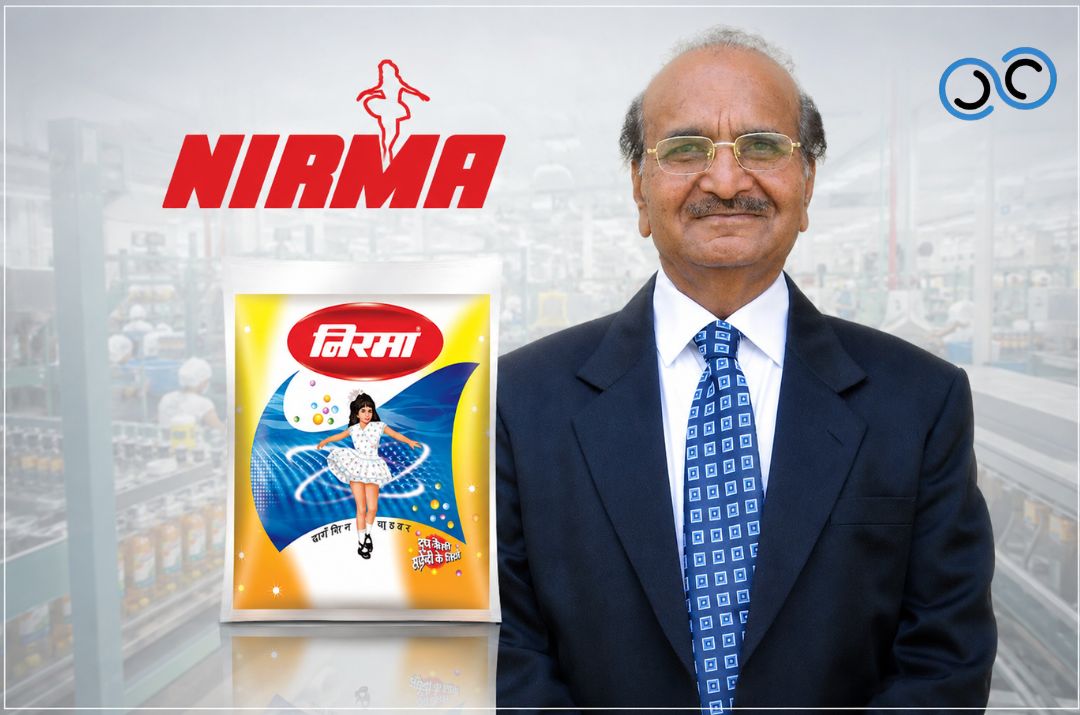

Nirma Success Story: How Karsanbhai Patel Built an Iconic Indian Brand
The little girl in the white frock on Nirma's detergent packets was not originally created as a fictional mascot.
She was Nirupama, the daughter of Nirma founder Karsanbhai Patel.
After losing his daughter in a car accident, Patel named his detergent brand Nirma after her and used her image in the brand's advertising and packaging to keep her memory alive.
But the story of Nirma is much bigger than its emotional brand story.
In 1969, Karsanbhai Patel was a government chemist who started making low-cost detergent in a small space at his home in Ahmedabad. He sold the product door-to-door on a bicycle, targeting consumers who could not afford expensive branded detergents.
What started as a small operation eventually challenged multinational FMCG companies and developed into a diversified Indian business group spanning consumer products, chemicals, cement, healthcare and other businesses.
Key Highlights
- Founder: Dr. Karsanbhai K. Patel
- Started: 1969
- Original product: Low-cost synthetic detergent powder
- Initial sales model: Door-to-door selling on a bicycle
- Original price: Around ₹3–₹3.50 per kg
- Major competitor: Hindustan Lever's Surf
- Peak detergent market share: Nearly 60% in 1985
- Current business: Consumer products, industrial chemicals, healthcare, cement and other businesses
- FY2026 Nirma Limited standalone revenue: ₹7,091 crore
- FY2025 consolidated revenue: ₹12,207 crore
- Founder recognition: Padma Shri, 2010
Who Is Karsanbhai Patel?
Karsanbhai Patel was born into a farming family in Gujarat.
He studied chemistry and worked as a laboratory technician before joining the Gujarat government's Department of Geology and Mining.
His scientific background became an important advantage when he began experimenting with detergent formulations.
Instead of trying to compete with established brands through expensive advertising or premium positioning, Patel focused on a different opportunity:
Make a good enough detergent and sell it at a price ordinary Indian households could afford.
That decision became the foundation of Nirma's business model.
How Did Nirma Start?
In 1969, Karsanbhai began producing detergent powder at home.
According to historical accounts, the operation started in a roughly 100-square-foot space, where Patel mixed and packed the detergent himself.
He would then take the packets on his bicycle and sell them directly to households.
At the time, branded detergent was considerably more expensive.
Surf was selling at around ₹13–₹15 per kg, while Patel positioned Nirma at roughly ₹3–₹3.50 per kg.
That price difference became Nirma's first major competitive weapon.
Why Did Nirma Become So Popular?
Nirma identified a massive gap in India's detergent market.
Premium brands were targeting consumers who could afford relatively expensive detergents.
Karsanbhai Patel instead focused on the middle
- and lower-income consumer.
His proposition was straightforward
Good cleaning performance + affordable price
This was an early example of market-penetration pricing.
Rather than asking consumers to pay more for a premium brand, Nirma made detergent accessible to households that previously relied more heavily on laundry soap.
The strategy worked.
Nirma gradually expanded from Gujarat into other markets and eventually became a national household name.
The Story Behind the Nirma Name
The name Nirma came from Nirupama, Karsanbhai Patel's daughter.
Historical sources report that Nirupama died in a car accident.
Patel chose to preserve her memory through the business by naming the detergent after her.
The original Nirma girl also became associated with the brand and appeared in advertising and packaging.
This transformed a personal tragedy into one of India's most recognizable brand identities.
The emotional story was never the only reason Nirma succeeded.
But it gave the brand something extremely valuable
Memorability.
Nirma's Biggest Competitor: Surf
When Nirma entered the market, Hindustan Lever's Surf was a dominant detergent brand.
Instead of trying to beat Surf by becoming a premium competitor, Nirma attacked from a different direction.
Its strategy was
Lower price → mass-market adoption → high volume → wider distribution
Nirma's detergent was priced at roughly one-fourth of Surf in its early years.
That made the product attractive to a huge segment of price-sensitive Indian consumers.
This forced established players to respond.
Nirma wasn't simply competing for existing customers.
It was helping expand the detergent market by making branded detergent affordable to millions of additional households.
Nirma's Explosive Growth
Nirma's growth accelerated through the 1970s and 1980s.
By 1985, the brand had captured nearly 60% of India's detergent market, according to historical reporting by The Economic Times.
At that point, Nirma had moved from being a small challenger to becoming the market leader in detergent by volume.
This was remarkable because the company had started with a single founder, a basic manufacturing setup and a bicycle-based distribution model.
The business had essentially used
Low cost + mass distribution + strong branding + consumer understanding
to challenge an established multinational.
The Nirma Girl and Brand Marketing
Nirma's marketing strategy became one of its strongest competitive advantages.
The brand's famous advertising featured a girl in a white frock along with a highly memorable jingle.
The campaign helped create instant brand recognition across India.
The Nirma girl became more than a character in an advertisement.
She became a visual shortcut for the brand itself.
Consumers could recognize the product simply by seeing the girl on the packaging.
The combination of
Yellow packaging + Nirma girl + memorable jingle + affordable pricing
created exceptionally strong brand recall.
The Marketing Strategy Behind Nirma
Nirma's marketing success was not based only on advertising.
It combined several elements.
Value-Based Pricing
Nirma deliberately positioned itself as an affordable alternative to expensive detergent brands.
The product's low price made it accessible to a much larger customer base.
Mass-Market Positioning
Instead of targeting only affluent consumers, Nirma focused heavily on middle
- and lower-income households.
Direct Consumer Reach
The company initially sold directly to households, allowing Patel to understand customer reactions and build demand from the ground up.
Memorable Advertising
The Nirma jingle became one of the most recognizable advertising properties in Indian FMCG history.
Strong Visual Identity
The yellow packaging and Nirma girl created instant shelf recognition.
Together, these elements produced a powerful formula
Affordable Product + Mass Market + Memorable Brand = Scalable FMCG Business
Nirma's Business Model
Nirma eventually moved beyond simply selling detergent.
The company expanded vertically and horizontally into related businesses.
Its consumer portfolio includes
- Detergents
- Toilet soaps
- Edible salt
Its industrial businesses include
- Soda ash
- Caustic soda
- Linear Alkyl Benzene
- Other chemicals
- Processed minerals
The broader group has also expanded into
- Cement and building materials
- Healthcare and life sciences
- Other businesses
Nirma's official business information highlights its integrated operations and diversified portfolio.
The Power of Backward Integration
One of Nirma's most important strategic decisions was backward integration.
Instead of depending entirely on external suppliers for important raw materials, Nirma developed capabilities across parts of its chemical and detergent supply chain.
The company has manufacturing operations involving products such as soda ash and Linear Alkyl Benzene, which are important inputs for its consumer businesses.
This creates several potential advantages
- Better control over raw materials
- Lower supply-chain dependency
- Manufacturing efficiencies
- Greater control over product costs
- More consistent supply
Nirma's annual reports highlight captive raw-material linkages, integrated operations and logistics efficiencies as strengths of its business model.
This is a major reason Nirma's story is not simply an FMCG story.
It is also a manufacturing and vertical-integration story.
From Detergent Company to Diversified Group
Nirma did not remain a detergent company.
Over the decades, the group expanded into chemicals, healthcare and cement.
The company's diversification accelerated significantly after the 2000s.
In 2007, Nirma entered the US natural soda ash market through the acquisition of Searles Valley Minerals.
In 2016, it acquired Lafarge India's cement assets for approximately $1.4 billion, marking one of the company's biggest expansion moves.
The group later expanded further into life sciences.
This demonstrates an important principle
A strong core business can become the foundation for entering adjacent industries.
Nirma's Financial Scale
Nirma Limited is now far larger than the detergent business that created the brand.
For FY2025, Nirma Limited reported
- Standalone revenue from operations: ₹7,074 crore
- Consolidated revenue from operations: ₹12,207 crore
- Consolidated EBITDA: ₹2,074 crore
The FY2025 consolidated numbers included the contribution of Alivus Life Sciences, which became a subsidiary in March 2024.
For FY2026, Nirma Limited's audited standalone results reported
- Revenue from operations: ₹7,091 crore
- Profit before exceptional items and tax: ₹886 crore
- Profit for the year: ₹85 crore
The FY2026 results were affected by exceptional items, so headline profit should be interpreted carefully.
This distinction matters because Nirma today is a diversified industrial group rather than simply a detergent brand.
Nirma Was Not Built Through Venture Capital
Unlike many modern startups, Nirma did not grow through venture capital funding.
Its early growth came from the founder's own resources, operating cash flows and expansion of the underlying business.
Historical reporting also notes that Patel used a small loan of approximately ₹15,000 when starting the venture.
The important point is that Nirma's growth model was fundamentally different from the modern VC-backed startup model.
It focused on
Product → Sales → Cash Flow → Manufacturing → Distribution → Expansion
rather than
Funding → Growth → Valuation → More Funding
This makes Nirma an important case study for founders interested in building capital-efficient businesses.
The Biggest Struggle
Nirma entered a market dominated by established multinational brands.
The challenge wasn't simply manufacturing detergent.
It was convincing consumers that a product priced dramatically lower could still deliver acceptable quality.
That created a trust problem.
If a product costs a fraction of the market leader, consumers may naturally ask:
Why is it so cheap?
Nirma solved this through a combination of product performance, aggressive distribution, word-of-mouth and memorable marketing.
Once enough consumers adopted the product, the low price became an advantage rather than a signal of poor quality.
What Made Nirma So Strong?
Nirma's strength came from multiple layers.
Extreme Cost Leadership
The company built its early advantage around affordable pricing.
Deep Consumer Understanding
Patel understood that millions of Indian consumers wanted branded products but could not justify premium prices.
Distribution
The company gradually built a large distribution network that allowed Nirma to reach consumers across urban and rural markets.
Brand Recall
The Nirma girl and advertising jingle made the brand extremely recognizable.
Backward Integration
Control over key inputs helped support the company's cost structure and supply chain.
Diversification
The company used its capabilities in manufacturing and chemicals to expand into adjacent industries.
What Can Founders Learn From Nirma?
Don't Always Compete Head-On
Nirma did not try to beat Surf by becoming another premium detergent.
It found an underserved customer segment and built around it.
Lesson: If competitors dominate the premium market, look for the customers they are ignoring.
Price Can Be a Strategic Weapon
Low pricing alone is not a moat.
But low pricing supported by efficient manufacturing, distribution and supply chains can become extremely powerful.
Lesson: Cost leadership works when the entire operating model supports it.
Distribution Can Matter More Than Technology
Nirma's early advantage came from getting the product into consumers' hands.
For FMCG businesses, distribution is often as important as the product itself.
Lesson: A great product without distribution is still a small business.
Build Memorable Brands
The Nirma girl and jingle became deeply associated with the product.
Lesson: Brand recognition can become a long-term competitive asset.
Solve a Real Affordability Problem
Nirma didn't create demand from nothing.
It identified consumers who already wanted detergent but needed a cheaper option.
Lesson: Some of the biggest markets are created by making existing products accessible to more people.
Use One Business to Build the Next
Nirma used its experience in chemicals and manufacturing to diversify into multiple industries.
Lesson: Your first successful business can become the infrastructure for your next business.
Nirma's Biggest Strategic Insight
The most important lesson from Nirma may be this
Karsanbhai Patel did not start by trying to build a ₹20,000+ crore business.
He started by solving one simple problem
How can ordinary Indian households afford good detergent?
The business grew because the solution was
Affordable → Useful → Repeatable → Scalable
That is the same fundamental logic behind many successful businesses today.
Summary Takeaway
💡 **Key Takeaway:
- Nirma's success was built on more than a cheap detergent.
Karsanbhai Patel combined affordable pricing, deep customer understanding, direct distribution, memorable branding, manufacturing efficiency and backward integration to challenge multinational competitors and build a diversified Indian business group.
The emotional story behind the Nirma name made the brand memorable.
But the business was built by understanding something much bigger
Millions of consumers wanted quality products — they simply needed them at a price they could afford.
That is perhaps the biggest lesson from Nirma
Don't just build a product for the customers who can already afford it. Build a business that makes the product accessible to the customers who need it most.

.jpg)


.jpg)
.png)
.png)
.jpg)