
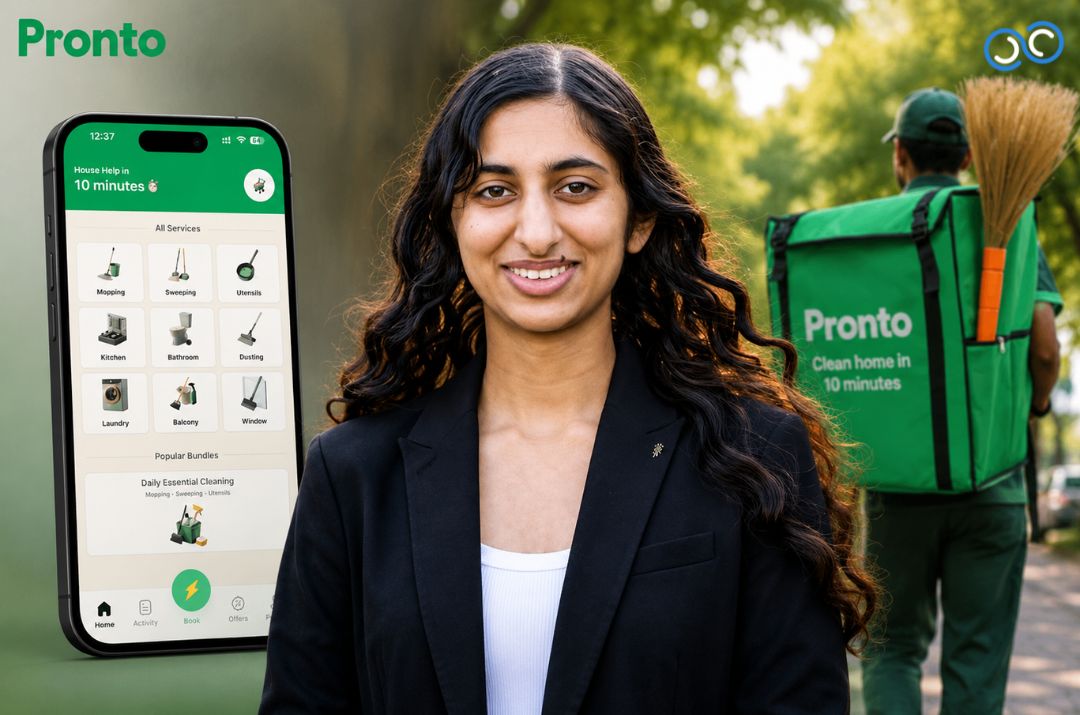

Pronto Startup Case Study 2026
Pronto is one of India's fastest-growing on-demand home services startups, aiming to organize the fragmented domestic help market through trained professionals, technology and hyper-local operations.
Founded by Anjali Sardana, Pronto offers household services such as cleaning, mopping, utensil washing, laundry and other everyday tasks, with services designed to be fulfilled within minutes in its active micro-markets.
Key Highlights
- Founder & CEO: Anjali Sardana
- Founded: 2025
- Latest valuation: $200 million
- Latest Series B: $45 million
- Total funding: Nearly $60 million
- Daily bookings: Around 26,000
- Active professionals: Around 6,500
- Operating presence: 10 cities and 150+ micro-markets
- Core model: Hyper-local, on-demand home services
Who Is Anjali Sardana?
Anjali Sardana is the founder and CEO of Pronto.
Before founding the company, Sardana worked in venture capital and investing, including experience with Bain Capital and 8VC.
She returned to India after recognizing an opportunity in the fragmented domestic help market and began building a technology-enabled platform designed to make household services more reliable, standardized and accessible.
What Problem Is Pronto Solving?
India's domestic help sector has traditionally been highly fragmented and largely informal.
Finding reliable household help often depends on personal referrals, local contacts and neighbourhood networks.
Pronto is attempting to formalize this experience.
Instead of simply connecting customers with independent workers, the company manages important parts of the supply side, including recruitment, verification, training, scheduling and service quality.
The goal is simple
Make household help as convenient and predictable as ordering a product online.
How Does Pronto Work?
Pronto follows a managed-service model.
The company recruits and trains professionals and organizes them around small geographic areas.
Customers can then request household services through the platform, while Pronto handles worker allocation and fulfilment.
Its services include tasks such as
- Cleaning
- Mopping
- Utensil washing
- Laundry
- Gardening
- Cooking and other household services
The model allows Pronto to control more of the customer experience than a traditional open marketplace.
What Makes Pronto's 10-Minute Model Different?
One of Pronto's biggest differentiators is its focus on speed.
Rather than trying to serve an entire city from a centralized workforce, Pronto builds dense micro-markets.
Workers operate close to customers, reducing travel time and allowing the company to dispatch professionals quickly.
This creates a simple operating advantage
Higher local density → shorter travel time → faster fulfilment → better worker utilization
The strategy is similar to the logic behind quick-commerce businesses, but instead of delivering products, Pronto delivers human services.
Pronto's Rapid Growth
Pronto has expanded extremely quickly.
The company grew from a small operation in Gurugram to thousands of daily bookings across multiple Indian cities.
By May 2026, Pronto was reported to be handling approximately 26,000 bookings per day, with around 6,500 active professionals*
The company has also reported strong worker retention, with more than 70% retention over a three-month period.
Pronto's Funding and Valuation
Pronto has attracted substantial investor interest in a relatively short period.
The company initially raised approximately $2 million at a valuation of around $12.5 million.
It later raised approximately $11 million in Series A funding at a valuation of around $45 million.
In March 2026, Pronto raised a further $25 million in Series B funding, taking its valuation to approximately $100 million.
In May 2026, the company extended its Series B by another $20 million, led by investor Lachy Groom.
This brought the Series B financing to approximately $45 million*
- and pushed Pronto's valuation to approximately $200 million.
The company had raised nearly $60 million in total funding*
Why Is Pronto Growing So Fast?
Pronto's growth can be explained by several important factors.
1. Large Offline Market
Domestic help is already a massive part of everyday life in Indian households.
Pronto does not need to create a completely new category. It is attempting to organize an existing but fragmented market.
2. Recurring Demand
Household chores are recurring problems.
Customers may require cleaning, dishwashing or laundry multiple times each month, creating opportunities for repeat transactions.
3. Hyper-Local Operations
Pronto focuses on building density within small geographic areas.
This can reduce worker travel time and improve operational efficiency.
4. Supply-Side Control
Instead of being purely an asset-light marketplace, Pronto invests in recruiting, training and managing its workforce.
This gives the company greater control over service quality.
5. Convenience
The promise of getting household help within minutes addresses a strong consumer pain point: uncertainty around availability.
Pronto's Workforce Strategy
The workforce is a critical part of Pronto's business model.
The company has built a large network of trained professionals, with approximately 99% of its active professionals reported to be women.
Pronto also focuses on worker training, standardized equipment, uniforms and worker support.
This creates value on both sides of the marketplace.
For customers
Reliable + trained + verified professionals
For workers
Structured work + better support + predictable opportunities
What Is Pronto's Competitive Advantage?
Pronto's competitive advantage comes from combining several operational elements rather than relying only on technology.
Its model can be summarized as
Micro-market density + trained workforce + operational control + fast fulfilment
When these elements work together, Pronto can potentially create stronger local economics and a better customer experience.
Pronto vs Traditional Domestic Help
Traditional domestic help is usually based on informal referrals and personal networks.
Pronto attempts to replace this with
Discovery → Verification → Training → Scheduling → Dispatch → Service
This makes the experience more standardized for consumers.
The broader opportunity is therefore not simply to digitize domestic help.
It is to formalize the entire domestic-services ecosystem.
What Can Founders Learn From Pronto?
1. Organize Fragmented Markets
Some of the biggest startup opportunities exist in industries that are already large but poorly organized.
2. Start Hyper-Local
Instead of expanding everywhere immediately, building strong density in a small market can create better unit economics.
3. Build Operational Moats
In marketplaces, technology is easy to copy.
Operational systems, workforce relationships, training and local density can be much harder to replicate.
4. Solve High-Frequency Problems
Businesses become more powerful when customers have a reason to return repeatedly.
Household services naturally provide recurring demand.
5. Speed Needs Reliability
A 10-minute promise only matters if the service is reliable.
The real product is not simply speed.
It is
Speed + Reliability + Quality
Summary Takeaway
💡 Key Takeaway:
- Pronto's success is not just about putting domestic help on an app. Its bigger opportunity is building a hyper-local operating system for India's fragmented household-services market.
By combining trained professionals, supply-side control, micro-market density and fast fulfilment, Pronto is attempting to bring the convenience of quick commerce to everyday household services.
For founders, Pronto offers an important lesson
The biggest startup opportunity is sometimes not creating a new market, but organizing an existing market that has never been properly structured.

.jpg)


.jpg)
.png)
.png)
.jpg)