
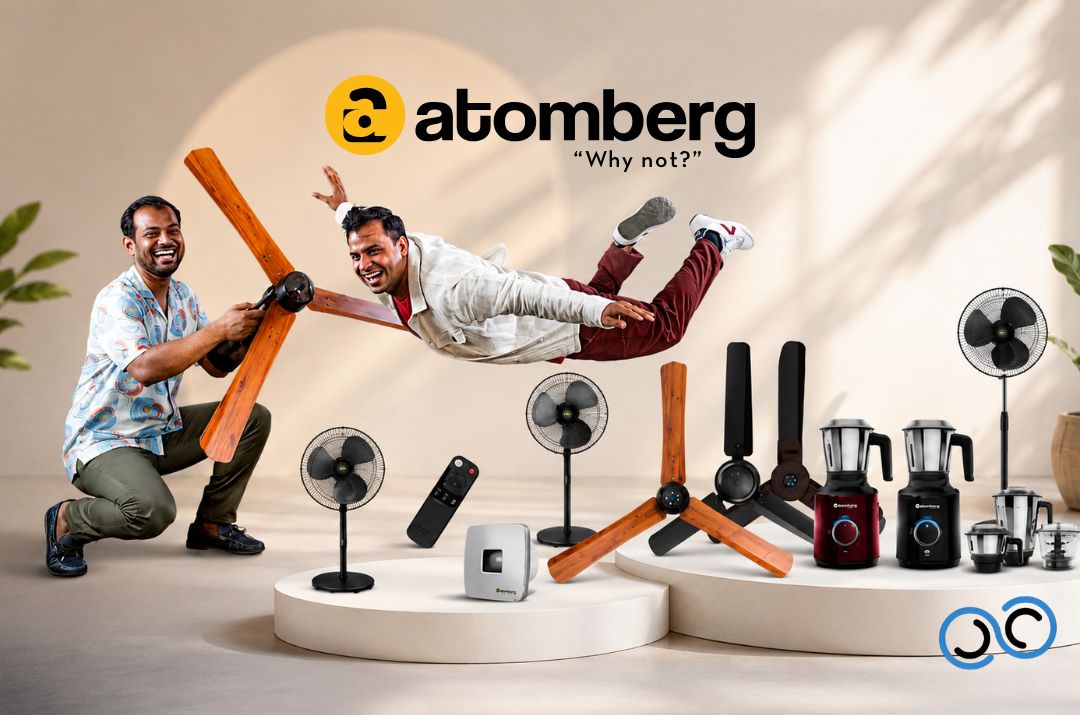

He rejected an ISRO job to sell fans.
In 2012,*
- IIT Bombay alumnus Manoj Kumar Meena founded Atomberg
Technologies.
A year later, his IIT Bombay hostel mate Sibabrata Das joined him as a co-founder.
Neither started with a grand plan to build a ₹1,000+ crore consumer electronics company.
For several years, they experimented with motors, power electronics and different business ideas.
Then they noticed something surprisingly ordinary
The ceiling fan.
An appliance that had remained largely unchanged for decades, especially when it came to energy efficiency.
They decided to build a better one.
The result was Atomberg, a consumer technology company that helped bring energy-efficient BLDC motor technology into the mainstream Indian ceiling-fan market.
Today, Atomberg has expanded beyond fans into smart home appliances and has crossed the ₹1,000 crore revenue mark.
The journey, however, was far from easy.
Key Highlights
Atomberg was founded in 2012 by Manoj Kumar Meena.
Sibabrata Das joined the company as a co-founder in 2013.
Manoj Meena had turned down an opportunity to work at ISRO to pursue entrepreneurship.
The founders spent several years experimenting with motors and power electronics.
Atomberg identified energy efficiency as a major opportunity in the traditional ceiling-fan market.
The company built energy-efficient BLDC fans that consume significantly less electricity than conventional induction-motor fans.
Atomberg initially focused heavily on online sales when consumers were still accustomed to buying fans from physical stores.
The company eventually expanded into offline retail and other smart-home appliances.
Its operating revenue crossed ₹1,000 crore.
Atomberg has raised significant institutional funding from investors including A91 Partners, Temasek, Jungle Ventures, Parampara Capital and Inflexor Ventures.
The company has filed its Draft Red Herring Prospectus for a proposed IPO.
Who Founded Atomberg?
Manoj Kumar Meena
Manoj Kumar Meena is the co-founder and chairman of Atomberg Technologies.
He is an IIT Bombay alumnus who chose entrepreneurship over a conventional technical career.
After completing his education, he turned down an opportunity to work as a scientist at ISRO.
Instead, he continued experimenting with technology and different business ideas.
The early journey involved multiple failed experiments before the founders eventually discovered the opportunity in energy-efficient ceiling fans.
Sibabrata Das
Sibabrata Das is the co-founder of Atomberg Technologies.
He was Manoj Meena's hostel mate at IIT Bombay and joined the company in 2013.
Das brought engineering and business expertise to the venture as the founders began developing their motor technology and building the company.
Together, the founders spent years working on power electronics and motor technology before turning their attention toward consumer appliances.
How Atomberg Started
Atomberg's journey did not begin with a ready-made business model.
The founders experimented with multiple ideas before identifying an opportunity in energy-efficient motors.
They noticed that traditional ceiling fans were still using relatively inefficient induction motors.
A conventional fan could consume roughly 70–90 watts, while a BLDC-based fan could deliver similar performance while using considerably less electricity.
That created an opportunity.
Instead of inventing a completely new product category, the founders decided to improve an appliance that already existed in almost every Indian household.
Their question was simple
Why hasn't the ceiling fan been built better?
That question eventually became the foundation of Atomberg.
Building the Technology
Atomberg's core innovation was its use of BLDC, or Brushless Direct Current, motor technology.
Traditional induction motors have been widely used in ceiling fans for decades.
BLDC motors can offer significantly higher energy efficiency while also enabling features such as remote control, speed regulation and smart-home connectivity.
Atomberg combined this technology with its own motor and controller engineering.
This helped the company differentiate itself from conventional fan manufacturers.
The company wasn't simply selling another ceiling fan.
It was selling a more efficient version of an everyday appliance.
Entering a Market Dominated by Giants
The founders were entering a market dominated by established brands such as Bajaj, Crompton, Havells and Usha.
These companies already had
Large distribution networks
Strong brand recognition
Thousands of retail relationships
Established manufacturing capabilities
Years of consumer trust
Atomberg had none of these advantages.
There was another challenge.
The founders wanted to sell ceiling fans online.
At the time, consumers were still accustomed to buying fans from neighborhood electrical stores.
Selling a relatively large and installation-dependent appliance through e-commerce was not an obvious strategy.
Atomberg therefore had to convince customers to trust a relatively unknown brand with an expensive household purchase.
The Online-First Strategy
Atomberg initially used e-commerce to bypass the traditional distribution structure.
This gave the company direct access to consumers and allowed it to explain the benefits of BLDC technology without depending entirely on traditional retailers.
The company focused heavily on
Energy savings
Product performance
Modern design
Smart features
Customer reviews
Direct consumer experience
This helped Atomberg establish an initial customer base before expanding aggressively into offline retail.
Eventually, the company developed an omnichannel model combining online sales with physical retail distribution.
The Cash Crisis
Growth did not come easily.
By FY19, Atomberg's operating revenue had reached approximately ₹37 crore, with the company producing around 1,000 fans a day.
But revenue growth did not automatically solve the company's cash-flow problems.
The startup experienced serious working-capital pressure.
Salaries were delayed.
Vendors were waiting for payments.
Funding conversations repeatedly fell through.
The company was building sophisticated hardware but was struggling to maintain enough cash to keep operations running.
At one point, the business was reportedly left with less than a month of cash runway.
For a hardware startup, this can be particularly dangerous.
Manufacturing requires working capital before products can be sold and cash can be collected.
Atomberg had to survive long enough for its technology and brand to gain market acceptance.
From Technology Startup to Consumer Brand
The turning point came when Atomberg began moving beyond being simply an engineering company.
It started becoming a consumer brand.
The company invested in product design, branding, online distribution, offline retail and customer experience.
The founders understood that superior technology alone would not be enough.
Consumers needed to recognize the brand.
They needed to trust the product.
And they needed to understand why paying more for an energy-efficient fan made economic sense.
Atomberg therefore positioned its products around a combination of
Energy efficiency + Design + Technology + Convenience
The BLDC Advantage
Lower Power Consumption
One of Atomberg's strongest selling points is energy efficiency.
Its BLDC fans can consume significantly less electricity than traditional induction-motor fans.
For consumers who use ceiling fans for several hours every day, the electricity savings can become meaningful over time.
Smart Features
Atomberg also introduced features such as remote controls, sleep modes, timer functionality and smart connectivity across its product range.
This helped transform the ceiling fan from a basic electrical appliance into part of the smart-home ecosystem.
Modern Design
Traditional ceiling fans were often treated as functional products.
Atomberg placed greater emphasis on aesthetics and product design.
This helped the brand appeal to consumers who wanted household appliances to fit modern interiors.
Building an Engineering Moat
Atomberg's biggest competitive advantage is its engineering capability.
The company invests heavily in motor design, electronics and controller technology.
Rather than simply importing generic motors and assembling fans, Atomberg has developed its own technology around BLDC motors and controllers.
This creates an engineering moat.
Competitors can copy the appearance of a fan relatively easily.
Replicating years of motor engineering, controller optimization, manufacturing knowledge and product reliability is much harder.
From Fans to Smart Home Appliances
Atomberg initially became known for its ceiling fans.
But the company gradually expanded its product portfolio.
Its products now include categories such as
BLDC ceiling fans
Mixer grinders
Smart locks
Water purifiers
Other smart-home appliances
This expansion allows Atomberg to move from being a single-category fan company toward becoming a broader consumer technology brand.
The strategy is similar to what successful consumer electronics companies have done globally:
Build trust in one category.
Then use that brand trust to enter adjacent categories.
Atomberg's Revenue Growth
Atomberg's financial journey demonstrates how dramatically the company scaled.
FY19
Operating revenue was approximately ₹37 crore.
The company was producing around 1,000 fans per day.
FY25
Operating revenue approached ₹958 crore.
Total income crossed ₹1,000 crore.
This represented a major transformation from the early years when the company struggled to raise capital and maintain sufficient cash.
FY26
Reported operating revenue reached approximately ₹1,293.77 crore.
The company had moved from being a small technology startup into a large consumer-electronics business.
Atomberg's Funding Journey
Atomberg eventually attracted major institutional investors as its business demonstrated product-market fit.
Some of the investors associated with the company include
A91 Partners
Temasek
Jungle Ventures
Parampara Capital
Inflexor Ventures
The company's funding helped finance
Product development
Manufacturing
Working capital
Marketing
Retail expansion
Technology
New product categories
The funding also gave Atomberg the runway required to compete with much larger incumbent appliance companies.
The IPO Chapter
Atomberg has now entered another major stage of its journey.
The company has filed its Draft Red Herring Prospectus with SEBI for a proposed Initial Public Offering.
The proposed IPO is expected to include a fresh issue of approximately ₹450 crore alongside an Offer for Sale by existing shareholders.
An IPO would mark a significant transition for Atomberg.
The company that once struggled to convince investors about the future of online fan sales is now preparing to enter the public markets.
Atomberg's Biggest Struggles
1. Multiple Failed Experiments
Before discovering the fan opportunity, the founders experimented with several different business ideas.
The early years were characterized by uncertainty and experimentation.
2. Lack of Consumer Trust
Selling fans online was unconventional when Atomberg started.
Customers were more comfortable buying electrical appliances from physical stores.
The company had to establish trust without the traditional retail network.
3. Strong Incumbents
Atomberg was competing against established appliance companies with decades of brand recognition.
4. Funding Challenges
The company experienced periods when funding conversations failed and cash became extremely tight.
5. Hardware Working Capital
Unlike software startups, hardware businesses require significant upfront investment in manufacturing, inventory and supply chains.
Atomberg had to carefully manage cash while simultaneously scaling production.
What Made Atomberg Successful?
1. It Improved an Existing Product
Atomberg did not invent the ceiling fan.
It made the ceiling fan better.
The founders identified an everyday product and looked for an important technological inefficiency.
2. Energy Efficiency Was a Strong Consumer Proposition
Electricity costs are a recurring expense.
A fan that consumes less electricity can provide a clear economic benefit over years of use.
3. Technology Became the Product Differentiator
Instead of competing only on design or price, Atomberg built proprietary engineering capabilities around its motors and electronics.
4. It Used E-Commerce to Challenge Traditional Distribution
The company initially used online channels to reach consumers directly.
This helped it avoid depending entirely on legacy retail infrastructure.
5. It Eventually Built an Omnichannel Business
Atomberg later expanded its offline presence, allowing consumers to discover and purchase its products through traditional retail channels as well.
6. It Expanded Beyond One Product
The company is now building a broader smart-home appliance portfolio instead of remaining dependent entirely on ceiling fans.
The Real Atomberg Advantage
Atomberg's biggest advantage is not simply that it sells energy-efficient fans.
It combines several capabilities
Engineering + Product Design + Brand + Distribution + Consumer Understanding
That combination is much harder to replicate.
A traditional appliance company can build a BLDC fan.
A technology startup can build smart electronics.
A D2C company can build a consumer brand.
But building all three capabilities together takes years.
Atomberg's Journey in Numbers
2012
Atomberg Technologies was founded by Manoj Kumar Meena.
2013
Sibabrata Das joined as a co-founder.
₹37 crore
Approximate operating revenue by FY19.
1,000 fans per day
Approximate production level around FY19.
₹958 crore
Approximate operating revenue in FY25.
₹1,000+ crore
Total income crossed this milestone around FY25.
₹1,293.77 crore
Reported operating revenue by FY26.
₹450 crore
Approximate fresh capital proposed through the IPO.
What Founders Can Learn From Atomberg
Don't Ignore Boring Industries
Some of the biggest startup opportunities can exist inside industries that don't look exciting.
Fans are not glamorous.
But millions of Indian households use them every day.
The opportunity came from improving something ordinary.
Look for Inefficiency
The founders didn't ask
"What new product can we invent?"
They asked
"Why is this existing product inefficient?"
That is often a powerful way to discover startup opportunities.
Technology Alone Is Not Enough
Atomberg spent years developing technology.
But technology only became commercially valuable when combined with
Brand + Distribution + Marketing + Consumer Experience
Hardware Startups Need Financial Discipline
A great product can still fail if the company runs out of cash.
Atomberg's early cash-flow problems demonstrate why working-capital management is critical for hardware businesses.
Compete Through Product Differentiation
Atomberg entered a market filled with established companies.
Instead of trying to win only through lower prices, it created differentiation through energy efficiency, smart features and design.
Summary Takeaway
💡 Key Takeaway:
- The biggest opportunity isn't always a new category. Sometimes, it's an old product that hasn't been built well enough.
Manoj Meena rejected an ISRO opportunity.
He teamed up with Sibabrata Das.
They spent years experimenting with technology.
They entered a market dominated by established appliance companies.
They struggled with funding and cash flow.
And eventually, they built Atomberg into a ₹1,000+ crore consumer technology company.
The lesson is simple
You don't always need to invent something completely new.
Sometimes, you just need to look at an ordinary product and ask
"Why hasn't this been built better?"

.jpg)
.jpg)
.jpg)
.jpg)